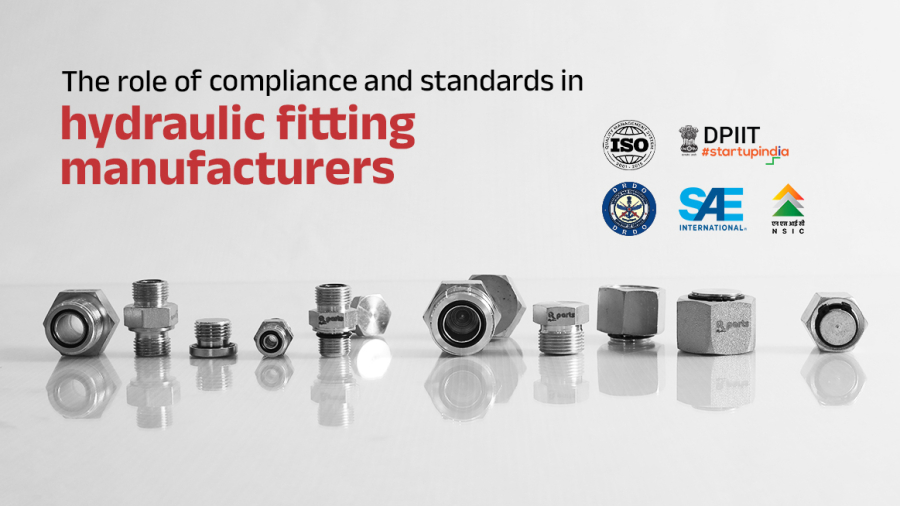
Hydraulic fittings may be small parts but their importance within a hydraulic system cannot be downplayed. Their function is to connect hoses and tubes as well as other components and assist the system to deal with pressure, temperature and flow effectively. Compliance and standards are therefore crucial considerations in the manufacturing of hydraulic fittings. Standards set guidelines for the dimension, interface, performance and tests for the fittings which help manufacturers to manufacture consistently performing fittings. In choosing hose fittings manufacturers in India, compliance becomes much more than just a certification process. It becomes an indication of the systematic way in which the manufacturer controls the product quality and compatibility.
What Compliance Means for Hydraulic Fitting Manufacturers and Why Standards Matter:
Compliance in a hydraulic fitting manufacturer refers to manufacturing of components in accordance with the established technical requirements suitable for their application. Requirements could be about dimensions, connections, material, pressure resistance, performance and tests among others. The purpose of compliance is to minimize the differences among components and have a consistent manufacturing and quality control basis.
This becomes particularly important because a hydraulic fitting does not work in isolation. Its performance depends on how it interfaces with the hose, tube, port and other components in the hydraulic assembly. SAE J516, for example, provides general and dimensional specifications for commonly used hydraulic hose fittings and states that the rated working pressure of an assembly using SAE J516 fittings and SAE J517 hose cannot exceed the lower pressure rating of the two components.
Standards also provide manufacturers and buyers with a common technical reference. Instead of relying only on visual similarity or individual manufacturing practices, dimensions and performance can be evaluated against established specifications. This is especially important in industrial applications where hydraulic systems may operate under high pressure and where a fitting failure can result in leakage, equipment downtime or safety risks.
The role of standards is much larger than that of the fitting itself. ISO 4413 outlines the general principles and safety requirements for hydraulic fluid power systems and components.
Following standards by manufacturers therefore becomes the foundation of consistency throughout the production process. To the buyer, compliance gives a better basis of determining whether a fitting is suitable for the application.
Key Standards Relevant to Hydraulic Fittings and Assemblies:
There is no generic standard that applies to any hydraulic fitting; the relevant standard is determined based on the design, connection type and the use of the hydraulic fitting. Important standards and resources to consult include:
- SAE J516 – Hydraulic Hose Fittings: Establishes general and dimensional requirements for hydraulic hose fittings that will connect hydraulic hoses that are classified according to SAE J517.
- SAE J517 – Hydraulic Hose: Specifies the characteristics of hydraulic hoses and is one of the most important references when assessing hose-to-fitting compatibility in assemblies.
- ISO 8434-1 – 24° Cone Connectors: Sets out general and dimensional requirements for 24° cone connectors, pressure and temperature rating information and qualification testing.
- ISO 8434-2 – 37° Flared Connectors: Deals with general and dimensional requirements and performance qualification testing for 37° flared connectors that are used in fluid power applications.
- ISO 4413 – Hydraulic Fluid Power: Contains general rules and safety requirements for hydraulic systems and components (design, assembly, installation and reliable operation).
However, the above-mentioned standards cannot be considered interchangeable certifications. Every of the standards relates to certain specifics of the hydraulic connections or system in question.
How Compliance Should Reflect in the Manufacturing Process:
Compliance is important only if it is shown in the manufacturing process of a fitting. The process of manufacturing should have the following elements:
- Material and Specification Control – Selection of Materials and Specifications depending on use and specifications.
- Dimensional Inspection – Inspection of critical dimensional requirements, profiles, threads and interface of connections to ensure consistency and compatibility.
- Hose and Fittings Compatibility Inspection – To confirm that selected fitting matches the corresponding hose, connection type, pressure and use.
- Controlled Machining and Manufacturing – Ensuring controlled production parameters to make sure that fittings stay consistent from production to production.
- Pressure Testing – Performing required pressure tests to ensure that component performs within its designated operational requirements.
- Crimping and Assembly Inspection – Control of crimp dimensions, fitting insertion and assembly of fittings where used in assembly of hoses.
- Visual Inspection – Inspection of manufacturing flaws, damages, contamination or any condition which may have an impact on assembly performance.
- Product Identification and Traceability – Appropriate product identification and production record to be able to trace components for any investigation.
The above process follows Rajdhani’s own quality process consisting of hose and fittings inspection, cut accuracy, fitting match up, crimping inspection, pressure testing, visual inspection, leakage test, marking of ferrule, cleaning, packing and finally inspection before shipment.
What Buyers Should Look for in Hose Fittings Manufacturers in India:
When considering the selection of hose fittings manufacturers in India, buyers need to consider the following:
- Applicable standards (SAE & ISO) for the required fitting
- Dimensions and connections of the fitting
- Pressure and temperature rating specifications
- Control over materials and products
- Compatibility of hose and fitting
- Pressure and performance test
- Dimension and visual inspection
- Identification and traceability of the product
- Controlled crimping and assembly process
- Documentation and product specifications
- Technical support for application
- Consistency in batches and repeat orders
Availability plays an important role when selecting hose fittings suppliers in India but should not be the sole factor. Technical capability to supply technically correct products, consistent specifications and sufficient product information that can be used by buyers to select the right products and assemble the fitting are some other requirements expected from a supplier in hydraulic applications.
The approach adopted by Rajdhani towards quality of hydraulic hoses and fittings is holistic and considers all aspects of the hydraulic systems. It includes verification of hose and fittings, selection of products based on standards, pressure and impulse test, dimensional verification, proper crimping and technical inspection.
Conclusion:
Compliance and standards provide a way to ensure the reliability, consistency and suitability of hydraulic fittings. They define the criteria against which manufacturers can control dimensions, interfaces, performance and quality at the stage of manufacture.
From the buyer’s perspective, however, compliance should not be determined just by finding the number of a standard in a product catalogue. What matters is how the requirements are turned into manufacturing controls, testing, inspection, compatibility and traceability.
In a hydraulic system, the fitting is only one of the parts in a connected assembly. The reliability of the fitting depends on its proper relationship with the hose, fitting, connection and operation conditions. Therefore, choosing a supplier with proper quality management processes and compliance with appropriate standards can minimize uncertainties prior to assembling the fitting.
Where a failure of the hydraulic systems can cause problems like leakage, downtimes, maintenance cost and safety issues, consistency is not a bonus feature but an integral part of the product.
Frequently Asked Questions:
1. Which standards are commonly associated with hydraulic fittings?
Standards that are relevant to each particular case should be determined based on the suitable type and application of fittings. SAE J516 applies to general hydraulic hose fittings, and ISO 8434 specifies connector types, including 24° cone and 37° flared fittings. ISO 4413 provides safety requirements for hydraulic systems and its components.
2. Does a standard-compliant fitting automatically make an entire hydraulic assembly safe?
No. All parts’ ratings, as well as proper assembly and application, determine how safe the entire assembly will be. As SAE J516 states, the rated working pressure of an assembly shall not exceed the lower applicable rating of either the hose or the fitting.
3. Why is dimensional accuracy important in hydraulic fittings?
Having accurate dimensions is important in order to ensure that a fitting is assembled with a certain hose, tube or port successfully.
4. Are all hydraulic fittings interchangeable?
No. Fittings can differ in connection type, dimensions, thread, sealing method, material, pressure rating and application. A fitting should be selected according to the specific hose, port and operating requirements.