
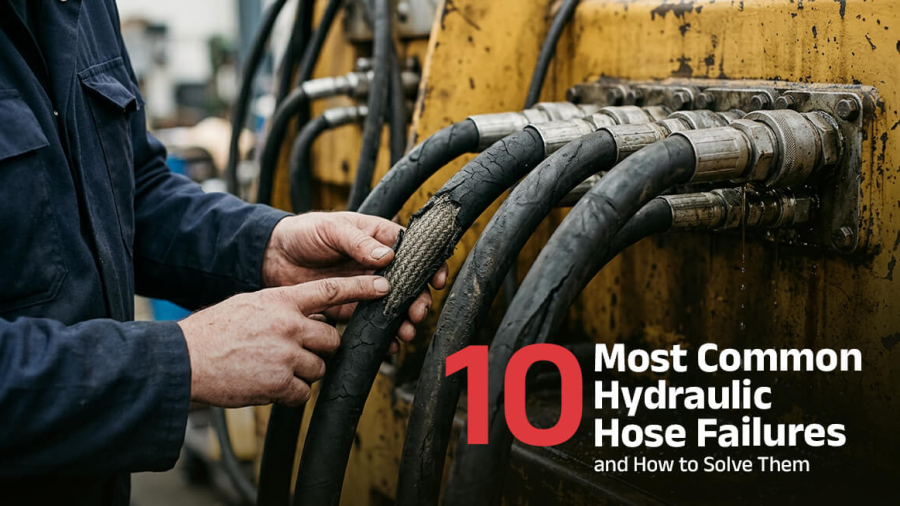
Hose failures usually do not occur in vacuum. Abrasion, pressure peaks, wrong routing, high temperatures, improper crimping and installation may damage the hose before it starts leaking, bursts or gets separated from its fittings.
What is important in this case is to understand the nature of the problem and find out what caused it in order to eliminate the source rather than replace the worn out hose.
Most of the hose failures are caused by one or more of these problems. Proper selection of a hose, correct assembly and routing minimise the probability of failure.
In this guide, we look at 10 common hydraulic hose failures, what causes them and what can be done to prevent them from recurring.
10 Most Common Hydraulic Hose Failures
1. Hose Abrasion
The outer cover gets abraded due to constant friction between the hose and equipment, other hoses and surrounding objects. This problem is solved by changing the route of the hose and using sleeves or guards when it is impossible to eliminate the friction.
2. Burst at the Hose Body
The hose bursts apart from its fittings because of excessive pressure, pressure peaks, kinking, compression or frequent bending. This problem can be addressed by reviewing the operating and pressure surge values, using appropriate hose and maintaining the required bend radius.
3. Burst Near the Fitting
The hose failure is found near the coupling due to excessive bending, insufficient hose length, movement of the fitting or wrong crimping. To solve this, we have to scrutinise the crimp, provide adequate assembly length and ensure the hose does not bend immediately at the fitting.
4. Leakage at the Connection
Fluid escapes from a threaded joint, seal or fitting seat. It can be avoided by inspecting the seal, threads, fitting alignment and connection state. Replace any damaged parts and make sure you assemble everything correctly.
5. Weeping at the Hose-Coupling Interface
Fluid starts to leak at the joint of the hose and coupling. This may happen because of improper assembly or crimping of the parts. The solution in this case is checking the dimensions of the assembly and crimping. Replace the assembly if the hose has not been properly attached to the coupling.
6. Coupling Blow-Off
The coupling breaks off from the hose because of the high pressure applied to the assembly. To avoid it, we can be cautious by making sure that the right hose, coupling and crimping methods are used. Never use incompatible hose and coupling systems.
7. Cracking from Heat
Excessive temperature causes the hose cover or tube to become brittle, crack or break down. The right thing to do here is choosing the proper hose for the operating temperature and avoiding excessive temperatures whenever it is possible.
8. Hose Twist
The hose gets twisted while assembling or working. What we can do here is assembling the hose without twisting and installing it in such a way that it is bent in the
9. Kinking or Crushing
If the hose exceeds the minimum bend radius or is squashed by any external forces, thus causing restriction in flow and damaging its internal structure, the problem can be resolved by correct routing and maintenance of specified bend radius and protection from compression.
10. Internal Tube Erosion
The inner tube may wear out due to inappropriate fluid used, high flow velocity or wrong hose choice. The solution to such a problem will be verification of fluid compatibility and choosing the right construction and size of the hose.
Quick Comparison: Failure vs. Fix
| Failure | Common Cause | Corrective Action |
| Abrasion | Rubbing/contact | Reroute + protect |
| Body burst | Pressure/flexing | Check pressure + routing |
| Fitting-end burst | Crimp/routing | Check crimp + assembly length |
| Connection leakage | Seal/fitting issue | Inspect + replace |
| Weeping at coupling | Incorrect crimp | Recheck assembly |
| Coupling blow-off | Poor assembly | Use correct hose-coupling combination |
| Heat cracking | Excessive temperature | Correct hose + heat protection |
| Hose twist | Twisted installation | Reinstall correctly |
| Kinking/crushing | Tight routing/external force | Correct routing |
| Tube erosion | Fluid/flow issue | Verify compatibility + sizing |
How to Prevent Hydraulic Hose Failures:
Some simple tips can help prevent premature hose replacement:
- Correct hose choice: Selection based on pressure‚ temperature‚ type of fluid‚ and end use․
- Correct hose routing: Preventing kinks‚ sharp turns‚ and abrasions in the hose․
- Maintaining bend radius: Never forcefully insert the hose into a bend tighter than recommended․
- Protection from abrasion of hose: Sleeves‚ guards‚ and other routing techniques․
- Checking the fittings: Confirming that the selection and installation are correct․
- Pressure control: Considering both the operating pressure and pressure spikes․
- Inspection: Checking for leaks and damage‚ wear‚ crushing‚ embedded fittings‚ and movement of other fittings․
- Replacement of damaged assemblies: Not using the hose showing any structural damage.
Conclusion
Failure of a hydraulic hose assembly is not always due to failure of the hose but can result from other factors‚ such as incorrect pressure rating‚ heat damage‚ improper installation‚ abrasion‚ improper crimping‚ or fitting damage․ After visually inspecting a failed hose assembly‚ it’s important to determine and correct the cause of the failure․
For proper and efficient operation of a hydraulic hose assembly‚ in addition to choosing the correct type of hose‚ other factors must be considered‚ including pressure‚ temperature‚ chemical resistance‚ bend radius‚ fittings‚ crimping‚ and installation․ Inspection of the hose assembly can help prevent leaks and ruptures by detecting warning signs early․
In Rajdhani, the concept of the inspection process is based on testing, traceability and technical inspection, whereby each and every hose assembly undergoes certain quality stages prior to dispatch. It is important to note that what is aimed at is not supplying the hose but ensuring that the assembly is suitable for the particular application.
Frequently Asked Questions (FAQs):
1. What are the most frequent causes of hydraulic hose failure?
Some of the main causes are: abrasion, pressure overload, wrong routing of the hose, inappropriate bend radius, overheating, wrong crimping and overall wear. Often enough a combination of installation and operation issues leads to the failure.
2. How can hydraulic hose failures be prevented?
One must use the right hose for the pressure, temperature and fluid used. Appropriate bend radius, absence of twisting and abrasion, proper crimping and fitting, as well as regular inspection of the assembly should be guaranteed.
3. How do I know when my hydraulic hose requires replacement?
One should look out for cracks, abrasions, exposure of reinforcing layers, kinking, crushing, leakage, heat damage, movement of the fitting and loosening of the coupling. An assembly which shows signs of structural damage requires replacement and not reuse.
4. Why do hydraulic hoses usually fail near their fittings?
The failures occur due to excessive bending, inadequate length of assembly, movements at the connections or improper crimping. Adequate routing, length of the hose and crimping are helpful in avoiding these kinds of problems.
5. Can a damaged hydraulic hose be repaired?
A structurally damaged hydraulic hose assembly should generally be replaced rather than patched. Replacing the complete assembly also provides an opportunity to identify and correct the original cause of failure before the machine returns to operation.