What Is Proof Pressure Testing of a Hydraulic Hose Assembly?
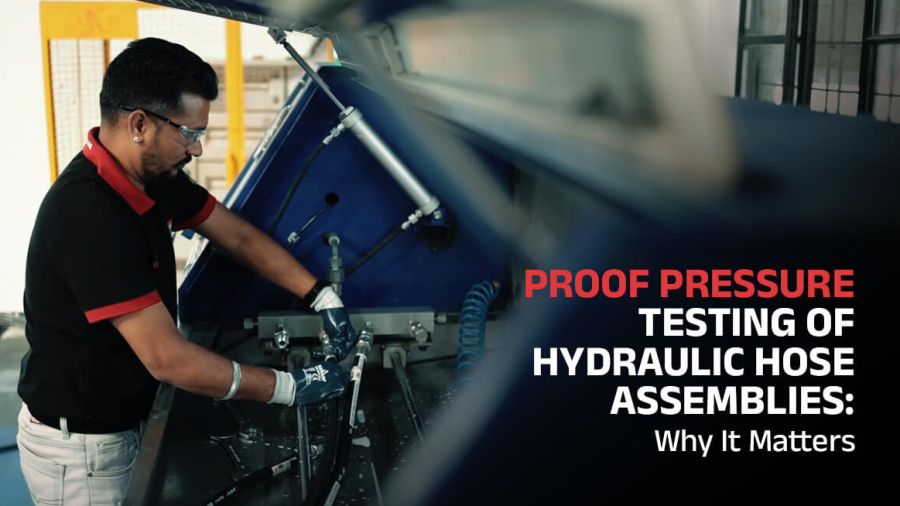
Proof pressure testing is a test performed on an assembled hydraulic hose assembly to confirm its integrity before it is made operational. It tests the assembly as a whole rather than the hose only; the hose, the fittings, the ferrules, the crimping and the assembly process.
It is because a hose that satisfies the minimum pressure criteria could end up being part of an unreliable hose assembly because of using the wrong fitting, improper crimping and poor assembly process. Hence, proof pressure testing is a controlled way of verifying hose assembly integrity.
It is especially crucial in hydraulic systems where hose failure could make the system fail and could raise safety concerns. Rajdhani quality process includes proof pressure testing wherever applicable, along with verification of the hose and the fittings, crimping inspection, visual inspection and leakage inspection.
How Does Proof Pressure Testing Work?
The proof pressure test is carried out on an assembled hose assembly by applying certain test pressure for a certain period and determining if the hose assembly withstands the pressure.
It is worth pointing out that the proof pressure is different from the operating pressure of the assembly. The proper proof pressure and time for holding the pressure depends on various factors such as hose specifications and assembly requirements among others.
For the purpose of testing, there could be conditions such as:
- Hose to fitting joint leakage
- Problems with the crimped joint
- Abnormal movement/deflection
- Signs of weakness in the assembly
- Pressure loss or signs of leakage
The objective is simple: Test the final product before exposing it to actual operating conditions.
Why? Because the performance of hydraulic hose assemblies does not depend only on each component but on the interaction between hose, fittings and crimping process.
Also, international standards emphasize this point of view. The latest version of ISO 18752:2025 (fifth edition, June 2025) specifies the requirements for hydraulic hoses and hose assemblies stating that the maximum working pressure of the assembly is dictated by the minimum maximum working pressure of the components. (ISO)
Proof Pressure vs Working Pressure vs Burst Pressure
All these three terms are sometimes mentioned in one context, but they denote different concepts.
| Parameter | What it means | Primary purpose |
| Working Pressure | The pressure at which the assembly is designed to operate | Normal operation |
| Proof Pressure | A specified test pressure applied to verify assembly integrity | Quality verification |
| Burst Pressure | The pressure at which the assembly ultimately fails during a destructive test | Failure/performance evaluation |
- The working pressure refers to the pressure that should be borne by the hydraulic hose assembly.
- Proof pressure is a planned verification process where the assembly is subjected to see whether it can withstand the required test pressures without excessive leakage or damage.
- Burst pressure test, on the other hand, involves destruction of the assembly since the intention is to ascertain the bursting point of the hose.
This is important since proof pressure testing should not be mixed up with burst testing. Passing a proof pressure test for a hydraulic hose assembly does not mean that it should be tested using the test pressure.
Also, there is no one size fits all ratio for proof and burst pressure to working pressure for each hydraulic hose assembly. This should always depend on the specific specification and test requirement.
For instance, SAE J517 specification is a general dimensional and performance specification for hydraulic hoses and it is stated in this specification that the maximum working pressure of an assembly shall not exceed the lower applicable pressure rating of its components. (SAE Mobilus)
Why Test the Complete Hydraulic Hose Assembly?
The performance capability of any hydraulic hose assembly depends on its weakest component and how those components were assembled.
The hose may conform to all its specifications, but there will still be problems with the assembly if:
- The hose and fitting do not match
- The fitting is assembled wrongly
- The crimp dimensions fall outside the required specification
- There is inconsistency in the assembly process
- The hose has been damaged during the cutting or assembly process
- The assembly is prone to leakage when put under pressure
That is why it is important not just to check the hose.
An effective quality process checks the whole assembly from selection of components up to inspection before shipment. The quality process documented by Rajdhani entails checking the hose and fitting, cutting, fitting matching, crimping inspection, proof pressure testing if necessary, and visual inspection for leakage before shipment.
This approach is evident in the industry standard as well. The SAE J516 standard on hydraulic hose fittings states that the rated working pressure of the assembly consisting of SAE J516 fittings and SAE J517 hose shall not exceed the lower working-pressure rating of the two components. (SAE Mobilus)
In practice, the assembly, not a component of it, is installed in the machinery. The quality of the assembly thus has to be evaluated as an assembly.
What Problems Can Proof Pressure Testing Help Identify?
Proof pressure testing does not attempt to anticipate all types of failures that may occur during the assembly’s entire period of operation. Nonetheless, it allows discovering assembly-related issues prior to dispatch.
Depending on the test procedure, proof pressure testing could reveal:
- Leakage at connections:
A proper hose assembly will hold up under certain test conditions. A leak indicates a fault associated with either a connection, fitting, or improper assembly. - Crimping issues:
Inappropriate crimping may impact the connection between the hose and fitting. Proof pressure testing is an additional way to inspect the connection beside dimensional and visual inspections. - Assembly inconsistencies:
In case when assembly occurs repeatedly, testing reveals whether the assembly process results in consistently good performance. - Uninspected Problems:
A hose assembly might appear to be fine from the outside even though it may have some defects revealed only under pressure.
It is because proof pressure testing is meant to become one of the steps in the quality control process and not the whole process itself.
The quality policy of Rajdhani includes testing, component verification, crimping inspection, dimensional inspection, visual inspection, leakage inspection, ferrule marking, cleaning and final assembly inspection.
The idea behind is quite straightforward – quality needs to be proven on the assembly level, not assumed from the individual components.
How Rajdhani Approaches Hydraulic Hose Assembly Testing
Assembly testing at Rajdhani is one of the stages of the general process of quality control rather than a separate procedure.
Rajdhani started 100% assembly testing in 2019 as a part of its approach to quality. Its current assembly process involves checking of the hose and the fittings, proper cutting of the hose, fit of the fittings, inspection of the crimping, pressure testing in case if applicable, leakage checking, ferrule marking, cleaning, and final inspection.
The approach corresponds to one of the main principles of hydraulic hose assembly quality: the quality of the completed assembly goes beyond the pressure rating of the hose itself.
Also, Rajdhani showed its assembly performance in action during EXCON 2025 by performing a live hose burst pressure test. The pressure of the assembly in question was estimated at 4,000 PSI, the standard burst pressure was 16,000 PSI, while the test reached 20,000 PSI. It is a particular example of a test and should not be considered the rating of all the assemblies of Rajdhani.
The point of such tests is not to show the bigger number but the significance of verifying how the assembled product behaves under certain pressure conditions.
Conclusion
Proof pressure testing serves as an important step in verifying the integrity of the assembled hydraulic hose assembly under the prescribed test conditions and detecting problems that might not be visible using component verification.
However, quality hydraulic hose assembly requires all steps to be considered, including proper component selection, crimping, dimension inspection, pressure testing when required, leakage detection, and final inspection.
The point to remember here is that a hydraulic hose assembly must be tested as an assembly and not simply as a hose.
When all relevant steps in the process have been verified, proof pressure testing is a part of a controlled process.
Frequently Asked Questions:
1. What is proof pressure testing in a hydraulic hose assembly?
Proof pressure testing is a controlled testing of a completed hydraulic hose assembly at a specified test pressure to verify its integrity under specified conditions. Proof pressure testing is a quality assurance test and should not be confused with operating pressure or burst pressure testing.
2. Is proof pressure the same as burst pressure?
No. Proof pressure testing verifies the integrity of the assembled hydraulic hose under specified test conditions, whereas burst pressure is the pressure at which an assembly finally fails under the conditions of destructive testing.
3. Why should the complete hose assembly be pressure tested?
Because the final assembly consists of multiple components and processes, including the hose, fittings and crimped connection. Testing the completed assembly can help identify leakage or assembly-related issues that may not be evident from inspecting the hose alone.
4. Does every hydraulic hose assembly require proof pressure testing?
The applicable testing requirement depends on the hose type, assembly specification, standard and application. Proof pressure testing should therefore be determined according to the relevant requirements rather than assumed to follow one universal test pressure.