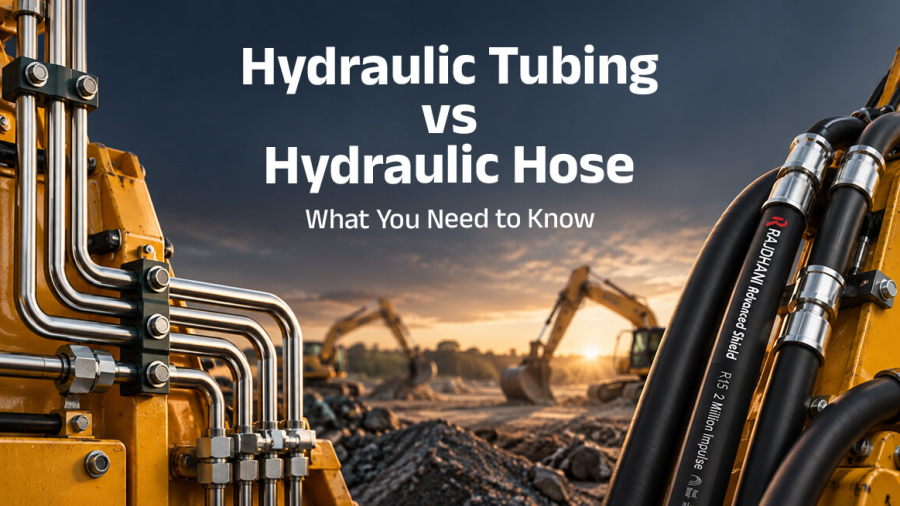
While both hydraulic tubing and hose lines convey pressurized fluid through systems, each one is appropriate under varying circumstances. Tubing is normally used in rigid lines where permanent routing and support can be achieved, while hose is usually the ideal option in cases where there is movement, vibration and need for frequent maintenance or more difficult routing. Various considerations like pressure, temperature, fluids compatibility, movement, bending radius and fittings should determine the most suitable option for an application.
The selection process is neither based solely on the flexibility nor the cost but on whether the fluid line will adequately respond to the needs of the hydraulic system and its operation.
What Is Hydraulic Tubing?
Hydraulic tubing is a rigid or semi-rigid fluid line which is usually made up of metals such as steel or stainless steel, depending on the intended use. It is bent and formed to route hydraulic components in a specific manner.
Due to its rigidity, tubing is the best choice for permanent hydraulic circuits, machinery panels and applications where the routing is mostly fixed. Support and proper forming are critical as any poor routing of the tubing will cause stress and vibration problems.
Tubing can provide a clean, permanent installation, but it requires the line to be correctly measured, bent and connected. Changes to the machine layout or replacement of a formed tube can therefore require more installation work.
SAE specification of the hose used is another important issue to consider. For instance, SAE J524 provides seamless low-carbon steel tubing suitable for use in hydraulic lines and in applications requiring bending and flaring of tubing. The current SAE listing was stabilised in December 2025, making it a useful reference when specifying this type of hydraulic tubing.
What Is a Hydraulic Hose?
The hydraulic hose is a flexible conduit consisting of an inner tube, reinforcing layers, and an outer cover. The flexibility of the hose is provided by its design and allows accommodating movement and vibration during the transportation of fluid under pressure.
Due to that, the hose is particularly suitable for use in mobile systems, flexible assemblies and vibrating equipment. Flexibility of a hose assembly also helps simplify maintenance as the assembly can be replaced without forming a new flexible line.
However, flexibility does not allow neglecting the restrictions on the usage of the hose. Bend radius, twisting, abrasion, temperature range, pressure and environmental factors all affect the performance of hose. Selection of hose should take into account the actual working environment instead of the nominal pressure rating.
The SAE J517 specification provides general and dimensional characteristics as well as performance requirements for commonly used hydraulic hoses. One of the most important considerations that this standard provides is regarding the maximum working pressure of a hose assembly, which cannot exceed the lower of the two ratings of the hose or fitting.
Hydraulic Tubing vs. Hydraulic Hose: Key Differences
| Factor | Hydraulic Tubing | Hydraulic Hose |
| Construction | Rigid/semi-rigid metal | Flexible reinforced construction |
| Flexibility | Limited | High |
| Movement | Best for fixed connections | Suitable for moving connections |
| Vibration | Requires proper support | Better suited to vibration and movement |
| Routing | Requires forming and bending | Easier around complex routes |
| Installation | Requires accurate forming | Easier to install and replace |
| Maintenance | Replacement may require re-forming | Assembly can be replaced directly |
| Typical use | Fixed hydraulic lines and panels | Mobile, vibrating or moving sections |
| Key considerations | Material, OD, wall thickness, pressure and fittings | Pressure, temperature, fluid, bend radius and fittings |
This difference is illustrated above, but in reality, hydraulic systems are usually more complex than this example. The same system might utilize both tubing and hoses, with both being used in the parts of the circuit where they have some kind of technical advantage.
When Should You Choose Hydraulic Tubing?
Hydraulic tubing is usually a good fit for cases when the hydraulic line will take a certain route which is known in advance and no need arises to allow for any significant movement.
This type of tubing may be successfully used in hydraulic panels, machine assembly and in stationary parts of industrial machinery where the line can be measured, shaped and mounted. After the installation, the fixed routing will give a solid connection between different elements.
In the case of moving connections or presence of vibrations, tubing is not the best solution. In these cases, an attempt to bend the line in order to allow for movements may lead to unnecessary stress on the line.
So the choice of tubing or hose should start from the consideration of working conditions.
When Should You Choose Hydraulic Hose?
In most cases, a hydraulic hose turns out to be a more realistic choice if there is a need for a hydraulic connection to be movable, flexible or capable of dampening vibrations.
This is especially true for construction and earthmoving equipment, agricultural machinery, mining equipment and other machines where cylinders, attachments or other elements are movable during the process. Hoses also become necessary if the hydraulic line needs to be routed through the restricted or variable space that would make formation of rigid tubing difficult.
On the other hand, selecting a hose needs to consider more than simply the pressure range. Working pressure, impulses, temperature, hydraulic fluid, bend radius, abrasions, vibration and environment are among factors affecting the proper choice of hose and its service life.
What should be kept in mind is the following: just because the installation is difficult, a flexible hose is not always the best choice. It also needs to be properly selected for the system.
What Should You Consider Before Selecting a Hydraulic Line?
Whether or not to use tubing or hose must be determined by the operating conditions of the hydraulic system. In choosing between these options, it is essential to take into account:
- Working pressure: The line selected should be capable of handling the highest possible system pressure as well as pressure impulses. For hose assemblies, SAE J517 states that the assembly must have a rating lower than the lower applicable rating of the hose or connector.
- Temperature and fluid: Temperature and the hydraulic fluid used could affect the material properties. The hose, tubing and all the sealing materials should be compatible with the fluid as well as the operating temperature.
- Motion and vibration: In case of any motion or vibration of the components, flexibility plays a role in hose selection. Hoses would be better suited for such connections.
- Bend radius and routing: Never force a hose into a bend that is tighter than the hose’s minimum bend radius. Any incorrect routing or twisting will shorten hose service life.
- Fittings and connections: The tube or hose is not the only component of the hydraulic connection. The thread matching and the type of the fitting and sealing are also to be considered.
In other words, selection should be based on the complete hydraulic connection, not just the line itself.
Why Correct Assembly Matters
Hose selection is just a part of the equation. Hydraulic hose assembly effectiveness is dependent on the right hose, proper fittings, right cuttings, proper crimpings and inspection.
This is where a holistic perspective becomes crucial. Assembly can have the right hose specifications and still cause issues because of improper fitting, out-of-specification crimping or too much stress put on the hose.
The way Rajdhani sees hydraulic hose assembly is that the whole assembly must be taken into account, not its separate parts. The process involves hose and fitting verification, proper cutting and crimping, testing and quality check before shipment.
The idea is simple – the assembly should fit the application, not the other way round.
Hydraulic Tubing or Hydraulic Hose: Which Is Right?
There is no single winner in terms of hydraulic tubing vs. hydraulic hose.
Tubing should be used in case of fixed and certain connections, which are properly shaped and supported. Hose is better in case of flexible connections, which require movement or vibration resistance.
Many hydraulic systems need both tubing and hose. The thing is that each segment of the hydraulic circuit should be examined in order to decide what kind of line is needed.
For any hydraulic application, pressure, temperature, fluid compatibility, movement, routing and connection requirements should be evaluated together before the final assembly is specified.
Frequently Asked Questions:
1. What is the main difference between hydraulic hose and hydraulic tubing?
The hydraulic tubing is defined as a rigid or semi-rigid line that is primarily meant for routing through fixed locations, whereas hydraulic hose is a flexible line that is better suitable for movements and vibrations.
2. Is hydraulic tubing stronger than hydraulic hose?
No. It is not necessary. Both strength and suitability depend on the particular specification, pressure ratings, materials, and applications. Always select a line for your particular application.
3. When do I have to use a hydraulic hose instead of tubing?
Generally, the hydraulic hose is preferred when there is some movement or vibration or any flexible routing of components is required. The hose may also be preferable when there is a need to replace or service the assembly regularly.
4. Can hydraulic hose and tubing be used simultaneously?
Yes. The tubing could be used for rigid portions, whereas the hydraulic hose could be used for the moving or vibrating connections. Proper fittings have to be used for the connection between them.
5. What should I consider before selecting a hydraulic hose?
Working pressure, temperature, fluid compatibility, hose size, bend radius, movement, vibration, environmental exposure and fittings compatibility. You have to ensure the whole assembly is suitable for your application, not just the hose itself.