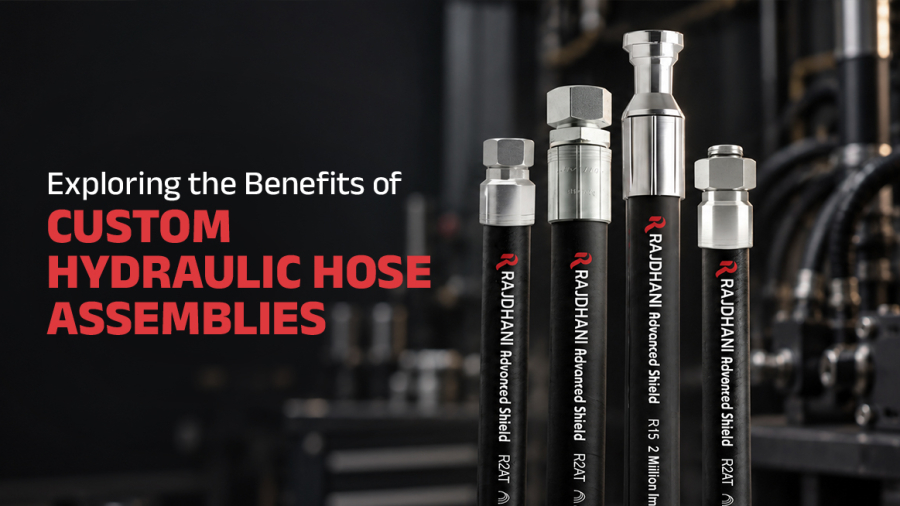
It should be noted that there is no such thing as the universal hydraulic hose assembly. Each machine requires individual specifications in terms of pressure, temperature, motion and routing characteristics. Accordingly, a custom hydraulic hose assembly takes into account these specifications and selects a hose, fittings, length and configuration that are required for this particular application.
As a consequence, the fit, routing and performance will be better. Moreover, in those cases, when the space is constrained or a constant motion of machinery is needed, the right assembly will reduce the stress of the hose and fittings.
But what is a custom hydraulic hose assembly? When is it needed, and why is it more advantageous than a standard one?
What Is a Custom Hydraulic Hose Assembly?
Custom hydraulic hose assembly is an assembly that is configured specifically for a machine or application.
- Hose type and size
- Length
- Working pressure
- Fitting type and orientation
- Routing and bend requirements
- Operating environment
- Hose protection
As a matter of fact, the assembly is configured according to the requirements of application rather than adaptation of application to the hose configuration.
When Are Customizations Required?
Standard assemblies can work well where application requirements are straightforward, but customisation becomes important when the installation involves specific:
- Space Constraints : Restriction of installation space could make it necessary to have a specific length of the hose or a particular orientation of the fitting.
- Moving Elements : If there are moving elements in a machine, it needs a special route that provides movement without strain and too much bending.
- Pressure and Temperature : The assembly needs to be appropriate for the real conditions of operation of the system.
- Connecting Requirements : Different connections and ports could require different kinds of fittings or particular orientation of the fittings.
- Environmental Conditions : Heat, friction, chemicals, ultraviolet light and other factors could influence hose and protection selection.
Key Benefits of Custom Hydraulic Hose Assemblies
Better Fit and Routing
The most obvious benefit of a custom assembly is that all of the hose’s dimensions, fittings and other parameters could be considered taking into account the specifics of a machine.
It would prevent you from having too long hose, tight bending and other problems. Proper routing could help to provide necessary movement and vibration and mechanical resistance to the assembly.
Good fit allows one to avoid many installation difficulties.
Correct Hose and Fitting Compatibility
A hydraulic hose assembly is a connection that consists of more components than just a hose.
It should be compatible with all of the pressure, fluid and application requirements. The maximum working pressure of an assembly will also depend on the lowest pressure rating for any of the components in the assembly.
A custom assembly ensures that all of these components are selected at the same time rather than as separate parts.
Improved Reliability in Demanding Applications
Hoses operate under pressure, movement, vibration, and environmental stresses. An assembly design that does not take into consideration these stresses may put too much stress on the hose and its fittings.
A custom assembly enables the various factors such as bend radius, movement, routing, pressure and operating environment to be taken into account before the installation of the assembly. Parker emphasizes that the operating environment and routing affect the hose service life directly while Gates mentions that vibration and routing should be considered when assembling and installing the hoses.
The idea here is simple: to reduce the unnecessary stress and create the assembly that is appropriate for the real operating environment.
Easier Installation and Maintenance
An assembly made according to the specified length and fitting configuration can save time when assembling or replacing the assembly.
Rather than trying to adapt a standard assembly to meet the requirements of the application, the assembly can come pre-assembled according to the application’s needs.
In instances where uptime is critical, the right replacement can also help in making maintenance more predictable.
Application-Specific Protection
Not all hoses work in the same environment.
Where the assemblies are subjected to abrasion, heat, UV rays or any external condition, extra protection can be chosen based on the application. The selection for protection in the Rajdhani range includes the following types of protection: thermo protection, nylon sleeves, spring guards, spiral wrap and fire sleeves.
Choosing the right protection is therefore not just another accessory. It is part of designing the assembly to suit the environment in which it will work.
Custom vs. Standard Hydraulic Hose Assemblies
| Factor | Standard Assembly | Custom Assembly |
| Length | Pre-defined configuration | Selected for the application |
| Fittings | Available standard configurations | Selected according to connection requirements |
| Routing | Limited by available configuration | Planned around machine routing |
| Installation | May require adjustment | Configured for intended installation |
| Application | General requirements | Specific operating conditions |
| Protection | Standard options | Selected according to environment |
| Replacement | Standard configuration | Matched to machine requirement |
Customising does not automatically mean improvement. The assembly still requires the right hose, the right fittings, correct crimping, correct routing and relevant tests. The value of customising lies in the right assembly.
What Should Be Considered When Specifying a Custom Assembly?
Customising an assembly requires choosing the right assembly based on the actual operating environment of the hydraulic system.
Operating Pressure : Choose the assembly based on the highest operating pressure, as well as any pressure spikes.
Temperature : Consider the fluid temperature and environmental temperature as well.
Compatibility with Fluid : Hose, fittings, seals and any other wetted parts must be compatible with the fluid in question.
Movement & Bend Radius : Consider movement of the machine, vibration and the bend radius required by the hose during operation.
Fittings & Connection Type : Choose the right type, size, orientation and connections of the fitting for the machine.
Length & Routing : Calculate the length based on actual installation, allowing for enough movement without having too much slack or tension.
Environment & Protection : Take into consideration abrasions, heat, ultraviolet light, chemicals and other environmental factors which could affect the assembly.
Where Are Custom Hydraulic Hose Assemblies Useful?
Custom hydraulic hose assemblies have distinct advantages wherever the hose routing, machine movement, space and operating environment require a particular arrangement.
- Some common applications for custom assemblies include :
- Construction Equipment
- Mining and underground mining
- Steel plants
- Cement and process plants
- Agricultural and farm equipment
- Railway equipment
- Defence related applications
- Public sector undertakings and OEM manufacturing
- Machinery
This is the kind of application where one would expect hydraulic hose assemblies to perform reliably in difficult operating conditions.
Conclusion:
The assembly must be chosen on the basis of application rather than availability of a standard configuration.
The appropriate length, hose, fittings, routing, protection and pressure ratings will make the assembly more suited to the machine and its environment. Customisation is therefore essential whenever standard assemblies do not suffice in meeting the requirements of the application.
The principle is clear:
The correct assembly starts with knowing the application.
In Rajdhani’s case, the focus is on the whole hydraulic connection – from the selection of hoses and fittings, crimping through testing to quality inspection – not on individual components. This is the basis of the Rajdhani customisation approach.
Frequently Asked Questions (FAQs):
1. What is a custom hydraulic hose assembly?
A custom hydraulic hose assembly will be configured based on the requirements of the machine or application – the type of hose, its length, type of fittings, pressure, routing and other operational conditions.
2. What are the main benefits of custom hydraulic hose assemblies?
They will offer a better fit and routing, correct hose and fitting compatibility, easier installation, specific protection against the operation conditions and better suitability for difficult conditions of use.
3. When should I choose a custom assembly instead of a standard one?
A custom assembly will be recommended in cases where the application includes special space restrictions, machine movement, unusual connection requirements, extreme pressure or temperature or environmental exposure conditions.
4. What factors should be considered when specifying a custom hydraulic hose assembly?
Working pressure, temperature, fluid compatibility, hose diameter, length, bend radius, machine movement, fitting type and orientation, routing and environment conditions are key considerations.
5. Does a custom hydraulic hose assembly always perform better?
Not necessarily. Customisation is helpful if it meets the requirements of an application. The assembly will still require compatible.